
Probablemente mi ultima entrevista como co-foundador and CEO de Ansca, hecha por Lou Esfera en >>
Probably my last interview as co-founder and CEO of Ansca by Lou Esfera here >>
Mil gracias Lou pou una entrevista muy buena.
Carlos.
There are 34 posts filed in ansca (this is page 1 of 4).
Inc Magazine writes an article on “5 Ways to Make Your App Take Off” and chooses our Corona SDK as the #3 way to make your apps soar.
3. Try Corona by Ansca Mobile.
Corona is the world’s No. 1 mobile app development platform and many developers have found that by using it not only do their apps work better, but they get more downloads. That’s because Ansca Mobile has partnered with some review sites and podcasts for apps such as 148apps.com, CrazyMikeApps.com, AppShrink.com, Experimental Game Dev Podcast, and MadDog Podcast.
Another great feature of the Corona platform is that it can quickly publish an app to multiple marketplaces simultaneously: the Apple App Store, Google Play (Android’s new name for its marketplace), Amazon (for the Kindle Fire) and Barnes and Noble (for the Nook Color tablet). And it’s cheap; a yearly subscription is only $349 or $199 if a developer only wants to build to one platform.
Here is the link to the article >>
Grinning from ear to ear.
Carlos.
Last night, February 15th, 2012, I had the pleasure of having dinner with the co-creator of the Lua language, Roberto Ierusalimschy. Roberto is a visiting professor at Stanford and is currently teaching a class in programming in Lua. The last time Roberto and I had dinner was in Rio de Janeiro, near PUC University, during the summer of 2010. I was visiting Rio during the World Cup, thought the games were all being played in South Africa, and took time out to meet with Roberto and dine with him.
Back then, at that dinner, we were joined by his wife, daughter and family friends. This time, it was just me and him, and a lot has happened since that dinner. I remember showing him some of the apps that had been created with Corona back then, and last night, I showed him some of the new and immersive games done in Corona. He pretty much wants me to give him a list of the games so he can install them on his iDevice. So, some of you, may get a promo request from me to give to Roberto, so he can install your app on his iDevice. How neat is that.
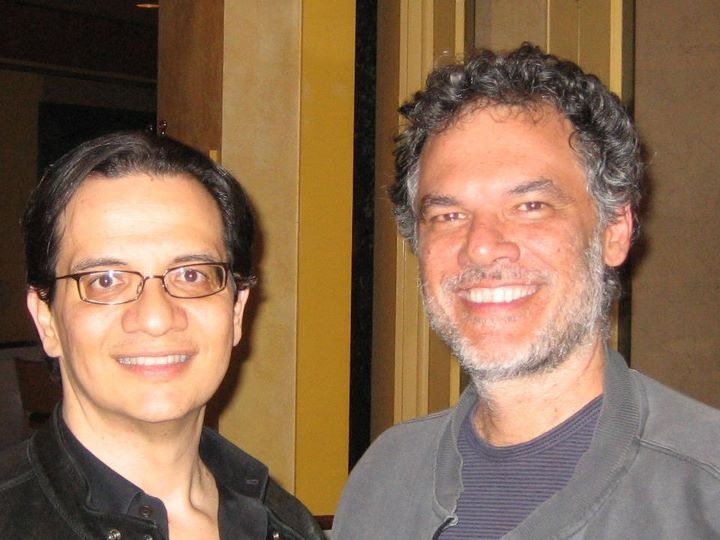
Aside from catching up in both the world of Ansca and personal, Roberto is looking forward to meeting Corona developers at a future meetup I plan to put together here at our HQ in Palo Alto. So if you are in the Bay Area, keep an eye out for the invitation to our meetup to meet with Roberto.
Link to Roberto’s page at PUC >>
Carlos.
And guess whose quote is number one?
Yours truly.
It became too much of a tangle. At the end of the day the focus on what was important was lost, and what is important are the developers.
Link: http://www.readwriteweb.com/archives/top_10_readwriteweb_quotes_of_2011.php
This is in reference to Adobe killing off Flash for Mobile devices. Read that article here >> Ex-Flash Manager: Adobe Ignored SmartPhones Until It Was Too Late.
Nice way to start the 2012.
C.
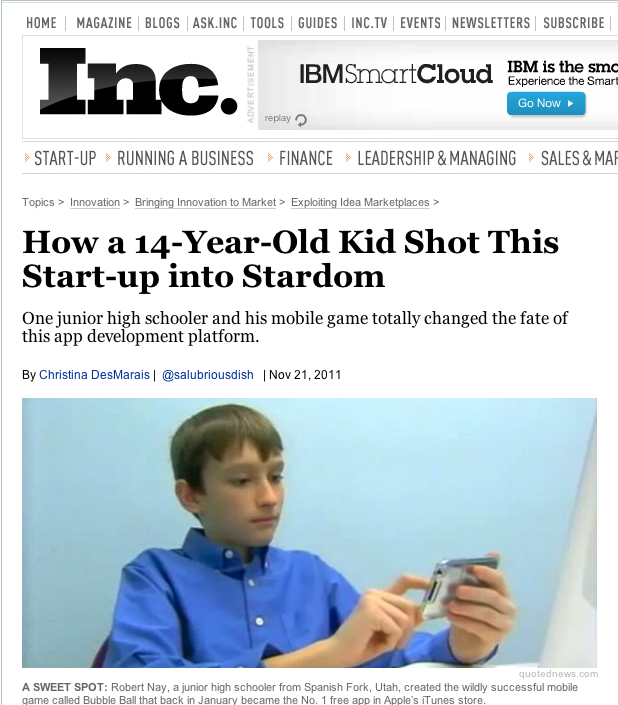
Inc Magazine reached out to me a few weeks back and asked for a story of how we got to where we are today. Here is the resulting article.
Read Article >>
Thanks,
Carlos
Tenia rato de querer tener mi presentacion de los 10 Mandamientos Para Empresarios en Español por mucho tiempo. Gracias a Gissela Peralta de Paraguay que escribio un blog sobre mi que me hizo realizar la importancia de la presentacion para los lectores que no hablan ingles, sino, el idioma “Castellano ;-)”.
Para mas informacion sobre el blog de Giessela, vean el link de “Maestros del Web”.
That’s right. Three years ago nobody knew who the hell we were. I would tell people I had started my company and it was a mobile company and nobody had a clue as to what I was working on, let alone understand the market the way Walter (my co-founder) and I did.
We started the company in mid 2008. We started the tireless and sleepless nights of VC funding in 2009. And Finally on 09/09/09 we got funded at the tune of $1 million dollars.
That was in 2009. During most of 2010, again, nobody knew who we were. We had a shit of a website, hardly any apps, no traffic whatsoever, no active developer community, and we were burning cash just like a normal startup so the future never seen brighter.
Then in 2011 things turned around, thanks to 14-year old Robert Nay, from NayGames, who wrote Bubble Ball. The mainstream media picked the news of a 14-year-oldtumbling Angry Birds (seasons) off its number one perch on the iTunes AppStore and suddenly, not only was he on the spotlight, thanks to a Good Morning America Segment, we were on the spotlight too. We were the technology that was used to topple the fowl juggernaut and used by a precocious 14-year-old with hardly any formal gaming and programming background.
Then the rest like they say, its history. We had another Corona SDK app, Blast Monkeys, by Yobonja, hit the number one spot on the Android Market during the summer, and the Amazon Appstore has featured several Corona SDK apps on their store.
Yet today, I have received numerous e-mails and tweets from non-Corona developers as to how I feel as Adobe Flash finally catches up to us. Really? Seriously? Three years ago nobody knew Ansca and our Corona SDK framework and today, I am receiving flak by Flash developers telling me that we are doomed and that Flash is far superior to Corona SDK and that I must be shitting in my pants as one twit mildly put it.
So, let me get this straight, Adobe being a $3 billion dollar company, with a team of about 200 developers for their Flash/AIR product finally catches up to us? And I should be shitting in my pants?
I think it is the other way around. I like to think of it as a bunch of rebels, pirates, good for nothing bunch of mavericks, running a puny startup funded to what would amount to be what Adobe spends in toilet paper in a day has given the Adobe Flash team a run for its money.
And I got news for you, if you think that I am afraid of Adobe. Hell, I used to work there, and the one thing I know is that we will out perform, outwit, out shine and outdo them anytime, anywhere, anyplace. Aside from having a weak CEO, Adobe’s other big flaw is corporate bureaucracy also known as corporate bullshit. And here at Ansca, we have none of that, and the only proof that needs to be highlighted is the fact that it was our developers who nominated us to the Dow Jones/Venture Wire FastTech 50.
And our commitment is to our developers, that’s our number one priority, to give them the best tool for the job. No Bullshit.
We are a fifteen people startup, and we gotten noticed by some of the most discerning Flash users, and made it into the Adobe Compete email alias. Hell yeah. Bring it.
So three years ago….
Carlos.
Imagine my surprise when I read the email that we had won Dow Jones/VentureWire Most Innovative Startup from the FastTech 50 list.
Best part, it was voted by our users. Our developers basically elevated us to the top and I couldn’t be more proud of our developers and of course our team over at Ansca for their hard work, dedication and indefatigable commitment on making our Corona SDK that much better and the de-facto industry standard when it comes to 2D mobile gaming frameworks. Yes, I sound like an infomercial, but our developers have chosen, and having our developers vote us into the FastTech 50 is something noteworthy and to be proud off.
Read more about what I had to say over at my company’s blog.
Carlos
Innovation Paralysis
It shouldn’t be a surprise to all of us here what has been happening in our industry in regards to innovation and the paralysis wrought into itself.
Why this innovation paralysis? For starters, companies get too big and complacent. Companies reach number one and then, it is a matter of holding on and milking the cash-cow to the last drop. Getting too big is not the problem actually, as I have seen this in smaller companies as well; holding on to the cash cow it until you suck the life of it, and even continue to maintain it after it has had its heyday, on life support. 😉
The most blatant and recent example of this paralysis, and I have seen plenty, is that of Nokia. Finland’s mighty mobile company, which at one point was producing 1 million phones every three days. MBA Schools had “case studies” on how Nokia’s assembly line and production lines were to be studied in order to build successful and profitable assembly lines. And today, we find ourselves pondering the future state of this one and formidable mobile handset maker Nokia. Am not saying that they are doomed and will fold in a few days, but it is the paradox of holding on to the cash-cow which produces innovation paralysis, near slightness and my favorite, the Emperor with No clothes Syndrome.
My personal experience with Nokia was that of hubris. They were Nokia, and you never asked how high, you just jumped.
That was a few years ago, circa 2005. We are half way through 2011 and seven “computer years” is not a lot considering the process of manufacturing new devices, etc, and look at Apple, reshaping the world of mobile, a company that was not and was not known to have become a mobile company. Apple, true innovators at heart, knowing, and knowing from experience, that you have to “sacrifice” ( a softer word than killing ) your first borne.
Apple killed the Apple ][ line in order to make way for the Macintosh. Lesson learned. Macintosh is cannibalizing its sales of its laptop, desktops with the iPad/iPhone. They learned their lesson early. They experienced it first hand. We all remember clearly when Apple was ready to go out of business. Can you imagine what this mobile world would look like if companies like Nokia, Microsoft, RIM would not have been shaken up. Android from Google was a competitor to RIM, what would this world look like. I can only imagine an OS like Windows 95 running on a Series 60 from Nokia and with the worst interface ever.
But what irks me the most is what his happening lately. Innovation paralysis is happening not just because the companies find a cash-cow and decide to milk it and CEOs walk around naked, but because of the pure and simplest form of stifling innovation due to of the patent wars. If I could draw who is suing who on a piece of paper, it would look like one giant doodle. Arrows pointing everywhere and no clear winner.
Patents are a mere form of innovation paralysis. Lodsys suing independent developers, Apple suing Google and Samsung, Microsoft suing HTC, Oracle suing Google and HP, HTC suing who?. Kodak suing Apple. Kodak up for sale. Buy Kodak so we can get the patents and lets sue the pants of everyone we can. Patent troll companies suing X, and Y and Z. Am not an expert on patents, nor do I want to be one, I am not allowed to read patents, or get near any piece of paper that describes a patent, but when there is this over abuse of power, it stifles innovation, and the ones who end up paying the price are the independent developers and users, aka your trusting loyal customers.
And honestly, I have not seen this blatant suing over patents in my history in the computer industry dating back to 1984. Some of the most “shocking” cases of yesteryear were those of when an executive jumped to a competing company and “took” trade secrets or employees with her. Nobody talks about monopolies anymore. Now days is not even “what’s in your patent portfolio? lets cross license” rather, “You are violating my patent. Pay up.”
The Shiny Object Syndrome
A few weeks back I introduced our Advanced Technologies Group inside of Ansca. See http://atg.anscamobile.com
I received a lot of feedback and big thumbs up for starting a new group focused entirely in researching advancements in the field of computer graphics, mobile, UI, programming principles and others. It is a group that can focus on new initiatives without disturbing the core of our Corona SDK team. It is, as I wrote “to be able to deliver forward thinking technologies that can ultimately either become products themselves or implement as features into our current or future products.”
So what does this have to do with the shiny object syndrome? A lot. Companies large or small think that being the best is by the number of features the product has vs the competition. Its true. I see our competitors trying to add features to their products because the marketing department thinks that winning is by having 10 more features than a competitor. The problem is, those ten so-called features are not essential to the success of its customers nor the success of the product. And worst, the features set is limited due in large part because the only thing against software development is time. Time is our only enemy. Getting there first is what matters says the marketing team. Really, how many search engines were there before Google?
I have seen products large and small suffer from “feature-ritis” and I know first hand what the syndrome can do to the product. It becomes a nightmare to maintain and to support. And when it comes to backwards compatibility, good luck. It can sink your product faster than the Titanic.
So what do features have to do with the shiny object syndrome? Exactly that. Two fold. One, this “shiny object syndrome” becomes the “must have” [insert your favorite new mobile/computer jargon] feature, completely disrupting the flow of the company’s product and engineering team, and two, the feature is half-ass implemented (crippled) because you only need enough of the feature (and not enough time) to be able to “check” it off on the feature list comparison matrix.
Strangely enough, we all suffer from feature-ritis, but there is a difference between the feature list of the MVF requested by the users, vs the MVF requested by marketing. (Most Valuable Features in case you didn’t recognize the TLA).
I come from a world of monolithic applications with 18 months cycles and with a code base over ten years old to mobile products where the lifecycle is in mere months. (Nokia was notorious for shipping new devices every so many months apart). In mobile, 18 months matters, companies have been bought (motorola) and companies throw away entire business units (Palm/webOS). And I have first hand experience on both sides of the fence (Illustrator/FlashLite).
And this is where our ATG comes into play. A new group chartered with the freedom to explore the Shiny Objects of our industry without disturbing our core Corona SDK engineering team.
One thing that all of you must understand, innovation/ideas/exploration/disruption and challenge is encouraged in my company, so everyone is free to participate to introduce ideas, etc., not just ATG, so I don’t want you to think that only ATG is pegged with coming up with new ideas. We will switch people around if we can and time permits, but the impetus behind this new group is to foster innovation, break out of the paralysis, and avoid the trap of the shiny object syndrome.
It is, after all, what I always believe in, in the entrepreneurial spirit in us, which drives us and enables us to innovate and forge ahead into uncharted territories.
And we are not afraid to change, to adapt and to disrupt. And we will continue to out-innovate, out pace and displace our competitors.
Carlos
A long time ago, during my late teens early twenty’s a friend of mine used to be a tennis instructor. He didn’t teach the fine art of how to play tennis, the didn’t coach, he didn’t teach you how to hit the ball and how to serve or how to move around the court, he didn’t teach, he certainly didn’t coach. His job, or as he would described it was that of the guy who you hired to play tennis against while learning how to play tennis. His clients would usually have hired a coach or an instructor or a motivational speaker, he was there to play against the students. He got to that position by being a really good player. He qualified at the state finals and won numerous tournaments throughout the state.
Couple of things to jot down, he came from a middle class hardworking family, he certainly wasn’t rich and his family could never afford to hire a coach, enroll him on private classes or sign him up to posh tennis clubs to learn how to play tennis. He played at the local park court, but played for hours on end. Often until he got kicked out by the park police and had turned off the court lights. He never had “tennis” attire. He never had a “graphite” tennis racket, nor “professional grade” tennis shoes. He just loved to play and by the sheer love became a top tennis player and instructor in the area. He was sought after and often was booked in advance for months. He demanded top dollar and made a good living at it for a while.
Since we have gone to the same high school and were part of the same group of school friends, we remained close friends well until after graduation. As he kept playing tennis and getting better and better he taught me a lesson. He never sat and said, here let me teach you this, this is of those lessons learned by osmosis. 🙂 Like I said earlier, while in high-school, he could not afford the super expensive tennis rackets, the shoes, nor the “attire”. Yet watching him play, he played with passion and determination and would beat the crap out of anyone on the other side of the court with am amazing grace. It was like it was just too easy for him to win. Yet, he would never, at least when I saw him play and then through the reports of friends and others, make you feel as though you lost. For him, it was a match, a game and he came to win and win he did.
The irony here is that he would win, and in his words, using a $15 dollar tennis racket. He could only afford regular tennis shoes, t-shirts and shorts, those that at one point were jeans and you just cut off the legs. That’s how he would win and win top games.
So what’s my point? What am I trying to get to?
Lets look at it from another perspective. A guitar has only six strings. A piano has 52 keys. Yet, how many variations of sounds can you generate from just six strings? and 52 keys? Some of the best music in the world, created by some of the best composers in the world, some of them even deaf, have endure time and time again and have become classics and every other adjective I can find out there.
If I we were to look at my friend, the tennis player, and say Beethoven, and if I could try to find a correlation, what would that be? that of two great artists who had love and passion for their respective skills. Both of them artists, and great artists use any tool to convey their passion. A tool, wether it is a tennis racket or a piano, is a method to convey their artistry, and their passion.
Carlos, where are you going with this? It is great and all but what does this have anything to do with either entrepreneurship or Corona?
Well, just like my friends canvas was that of a tennis court and Beethoven’s canvas was a stage, theater, etc, the new canvas is that of a mobile device. And the canvas size is not any bigger than the size of your palm or two palms if you are talking tablets.
Although, prior to the App Store, there had been app stores, Apple popularized it to what it is today. It enabled the democratization of not just building apps but also distributing them and creating an entire new industry of mobile apps, and with it, a new breed (insert trite jargon marketing phrase) of entrepreneurship was born.
And here is where both entrepreneurship and obviously Corona comes into this blog. Corona is a tool for your entrepreneurship passion in creating great mobile apps.
I have seen what you guys can do with our tool. I have been blown away by some of your creations. Heck, Walter and I can’t believe what you guys often create and how you can push us in the right direction to take Corona to the next level. Yet, with each new game I see, each one is different, each app I see, each one is different. Your creative mind and passion makes Corona do things I am blown away by. But more importantly, what really excites me the most is seeing not just what you can do with Corona but how Corona has changed peoples lives. It has enabled some of you follow a dream of becoming entrepreneurs and have done so quite well. Often, what was impossible is now possible. Mobile programming has a high learning curve in general, but Corona is one of those tools that lowers the barrier to entry without sacrificing quality and game play.
Which brings me to my closing argument 😉
Corona has allowed you to become the creative entrepreneur you have been wanting to become by producing some outstanding games and selling them at both iOS and Android market places. Some of you never thought it would be possible, but with a tool like Corona, it has become possible and you embraced the challenge and have become successful at it.
But the best part for me is that you have trusted Corona to be part of your entrepreneurial spirit and because of it, are establishing Corona as the new industry standard.
An what gives me that right to say Corona is becoming the new industry standard?
By having the number one game on the Android Market place Arcade and Action done in Corona, beating both Angry Bird and Angry Birds Rio. It is Monkey Blast by the Yobonja guys.
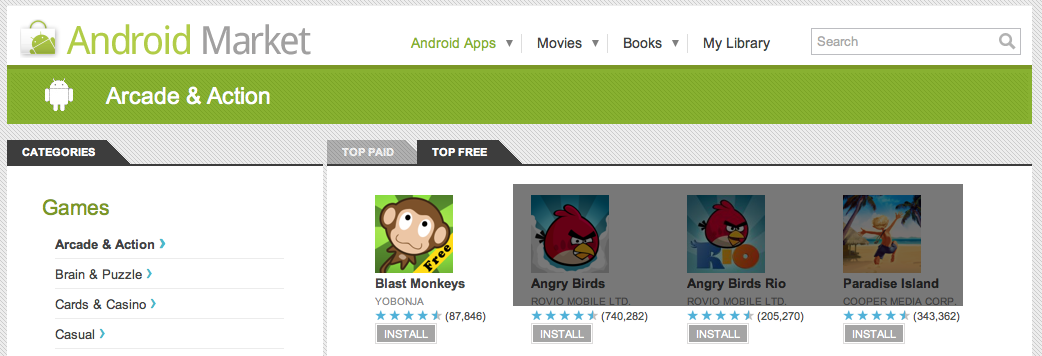
Not just that, six months ago, the number one game on the iTunes App store, Bubble Ball, by 14 year old Robert Nay was also done in Corona.
I am very proud of the fact that two completely different set of people using the he same tool, were able to create two different apps resulting in the two apps hitting the number one spot in two different markets and establishing said tool as solid, de-facto standard in mobile app development.
That common tool being Corona.
Now that’s what I would call Corona and the spirit of entrepreneurship.
Carlos.