The Warnock Algorithm or, rather, the Warnock Influence

John Warnock (co-founder of Adobe) is not just known for being the mind behind Adobe, PostScript, and Acrobat. Prior to Adobe, he worked for Xerox PARC and was one of the foremost scientists in leading the effort for JaM (“J” being John; “M” being Martin Newell, famous for the Utah Teapot), the precursor to PostScript. We all know the Xerox PARC story. This is not about Xerox. Read John’s first document on Acrobat, codenamed Camelot.

Even before Xerox, John Warnock was already famous. He was known for the Warnock Algorithm, a hidden surface removal algorithm published in most computer science graphics books. Imagine having an algorithm named after you. That’s impressive.

He comes from an elite group of distinguished graphics pioneers that studied at theUniversity of Utah. From Martin Newell, to PhongGouraudAlan KayEd Catmull (Pixar), Jim Clark (SGI, Netscape), Jim Blinn (NASA), Kajiya, and others. The advances we see today in movies like Toy Story and Avatar comes from the early research papers most of these folks wrote in the late 60’s and throughout the 70’s. Seriously, you have to check out Blinn’s bump mapping work and some early papers on fur rendering by Kajiya.

So, let’s party like it’s 1999. Here I was, a nobody, (heck, I still am a nobody!), a number at an office, a four-digit employee at Adobe. I had been working for them for almost three years and I’d just started working in the Illustrator group. Here I was sitting down, probably a week into the Illustrator group, staring at a 21” NEC CRT monitor full of windows of code and trying to find my way around it. I was facing the south side, and I had my back to the door when I heard footsteps and a knock on the door. It was Illustrator’s director of engineering. And what happened next, left me with an indelible mark.

It goes something like this:

Dave (Director of Engineering): Carlos what are you working on?
Me: Learning the code.
Dave: Well, I have a project for you that’s rather important.
Me: Uhh… Okay. *GULP*

[Butterflies and nervousness start to creep in. A project of importance — will I be able to deliver? What if I have no clue how this project works, and how it is put together???]

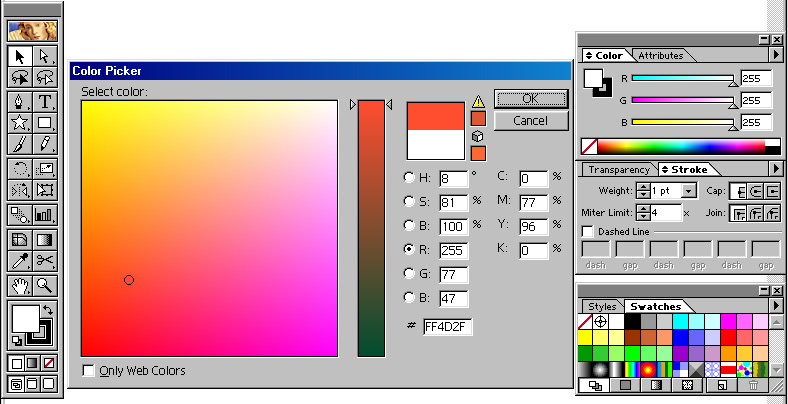
Dave: John Warnock wants to know why we don’t have a color picker in Illustrator.
Me: The John Warnock?
Dave: He just got off the phone with me and wants the Color Picker in Illustrator ASAP. I figured it would be a good way for you to break into the code.

[I s*** my pants]

Dave: Don’t worry. It’s just John.
Me: But, but, I don’t know how to …
Dave: Look, you’ve done this a thousand times. It should be relatively easy.
Me: Okay.
Dave: E-mail John and you two can figure it out. [Exits.]
Me: [I look and feel like I just saw a ghost, while continuing to s*** my pants.

That was it!

That was the moment that Warnock crystallized for me just how in-touch he was with his products and his engineers. It epitomized for me the “Warnock Influence.” He would roam the hallways at Adobe and chat with engineers. He would pop his head into an office and start talking with the engineer as if they had known each other for years. Chuck Geschke(Adobe co-founder) would do the same. A former co-worker during my Illustrator years came to my office one day and was in shock that Chuck had just called him after finding a bug in his SVG export code. It was not unusual to be sitting in the Adobe cafeteria, having lunch, and having John or Chuck come sit at your table and smack-talk.

I refer to the Color Picker story above often as an example of a founder who was passionate about his products as much as he was about his company and his employees. In another episode (not involving Warnock), I was at an event with that same Director of Engineering and, when introducing him, I said I work for him. He corrected me, simply saying “No, we work together.

Coincidentally, Dave Lazarony — that now-former Director of Engineering for Illustrator(who later became one of the individuals responsible for making the Adobe Creative Suite) — currently sits on our advisory board and has been my mentor for a number of years. We first met around 1990 at a puny little company in Miami called Deneba Software (nowACDSee), makers of Canvas, a former competing product against Illustrator. I credit him with quite a bit of stuff, as it was him who pushed me to submit my resume to Adobe and eventually get where I am today. :-)

Today, I don’t have people working for me — I work for my co-workers!  My job is to facilitate and do whatever it takes to allow them to execute on their job tasks to their fullest potential, and empower them to grow and make decisions independently. And, above all, I get my hands dirty. I build, debug, add features, and fix bugs on our code base.

All thanks to an industry giant for teaching me a life lesson.

* EDIT: Someone asked how did the Color Picker turned out? Here it is. *
Eight Elements To A Successful Game

One of the most exciting parts of being at Ansca, is that I get to see a lot of your great games all the way from inception to being released on the App Store and/orAndroid Market.

A lot of you send me your games to figure out a problem here and there, or ask me questions about how to do XYZ or this-and-that. Some of you send me assets without blinking; other of you are reluctant to send me your assets because your game is the next Angry Birds and you don’t want anyone to see your creation. Some of you are reluctant to send me the code because the “code” is not pretty. Trust me, I’ve heard and seen just about every type of game, code design, and killer app — I’ve been working knee-deep in the mobile space since 2004, when it was “pre-historic.” I’ve seen the whole gamut!

So, I see a lot of games and apps. Of course, I see a lot of Corona-made apps, but I also get to see a lot of non-Corona apps — and I get the same question asked over and over again.

What makes a game successful?

And with apologies to Cookie Monster, here we go…

While there is no magic elixir as to what makes a game a success. I have seen a series of elements that most successful games have and in Cookie Monster lingo, here is the Letter E for the key elements to a successful game

  1. The game must be engaging.
  2. The game must be entertaining.
  3. The game must be enjoyable.
  4. The game must be elastic.
  5. The game must be expandable.
  6. You must game must expose the user to other players.
  7. A game starts in an endemic area.
  8. A game, once it reaches mass appeal, it becomes an epidemic. It is viral and at this point unstoppable.

While it is difficult to articulate everything in one blogpost, I will do my best to see if I can make sense for each of the elments I mentioned above for a successful game.

A game must be engaging!  Think of having an engaging conversation — the conversation can be enjoyable or entertaining. Not all conversations are enjoyable, nor all conversations are entertaining. But if it has one or the other, you at least have three items from the list:engaging, entertaining, and enjoyable.  Now, think of a movie that is entertaining — not all the movies that you consider to be  entertainment may be enjoyable, but they could be engaging. The movie can have a plausible story that makes it entertaining, but may not be engaging. But certainly a movie that is enjoyable can be quite entertaining and engaging at the same time. Think of it this way: Entertaining = mass appeal. Simple.!

Now onto the rest! A game must also be expandable, something that you can keep growing. In the case of the Angry Birds franchise, there is Angry Birds SeasonsAngry Birds St. Patrick’sAngry Birds Valentine’s Day… Again, using a movie metaphor, think of a movie sequel. Although not always as good as the original, you can still continue the franchise.

Lastly, the game must be elastic. You have to take the gameplay to the breaking point. For me, this is the one of the top elements here (the key ingredient!). One has to pick up a game and be able to grasp it in matter of seconds. You must “fool” the player into thinking that it is easy, and have them go to the next level, continuing as the game gets progressively harder. That’s the elasticity of a game: stretch it is as far as you can while letting the player think that it’s still as easy as the first level.

If the game is elastic, it is also entertaining, enjoyable, and/or engaging. At this point, the player will want to share the game with other game players — then, you have successfully created a endemic game and the goal is to make it an epidemic!

And how do you expose your game to the masses? Create a Facebook Fan Page and a Twitter account for your company or game, create a video demo of your game. If you can afford it, try to get someone to write a press release for you and get the word out. Partner with a company that can get you the exposure;)

And remember: all apps and games — no matter how successful — are ephemeral. Don’t fall into the mental trap that your game will be on top of the charts for months on end, or a year or two. Today, we live in an ADD world and today’s headline is tomorrow’s old news. Your job is to always keep your game fresh, introduce new levels, build trust with your players, award them with coupon codes, etc. Making a game is not just about making pretty pixels move around the screen, it is a business. And part of that business is also the ability to market (evangelicize!) your game.

A little disclaimer: the stock inclusion of all the elements I mention is no elixir. It doesn’t guarantee your game to become a 40 million download juggernaut. Nevertheless, having some of these key elements in your game will make your game that much more enjoyableentertaining, and/or engaging to play — and if you get to that, you will automatically get more exposure.

After that, you could become endemic, and turn out to be the next big gaming “epidemic!” :-)

10,000,000 and Counting

I couldn’t be more happy with the 10,000,000 Corona SDK powered apps that have been downloaded in the past three months alone. It is a phenomenal milestone and one that I never thought it would happen in such a short amount of time. Also, I am also very happy to see the quality of apps and the volume of apps that are garnering the top spots at the app store. Again, in the past three months, we have had numerous apps on the #1 list, as well as on the top sellers spots on the app store.

Corona SDK is fast becoming the new mobile standard for 2D games. Go team Ansca!!

Find out more by reading the press release : 10,000,000 🙂

Carlos

Podcast Interview by FogView.

Back in October, Tom Newman from FogView did a podcast interview and we discussed all things Ansca, entrepreneurship and what it took to get to where we are today.

Part I
http://media.blubrry.com/fogview/media.libsyn.com/media/fogview/fv-056.mp3
length: 32:00

Part II
http://media.blubrry.com/fogview/media.libsyn.com/media/fogview/fv-057.mp3
length: 25:42

Link to FogView http://fogview.com/

Enjoy and feedback always welcomed….

Carlos